Firefighter heard ‘stop, stop’ before LaGuardia jet crash, but didn’t know who it was for, NTSB says
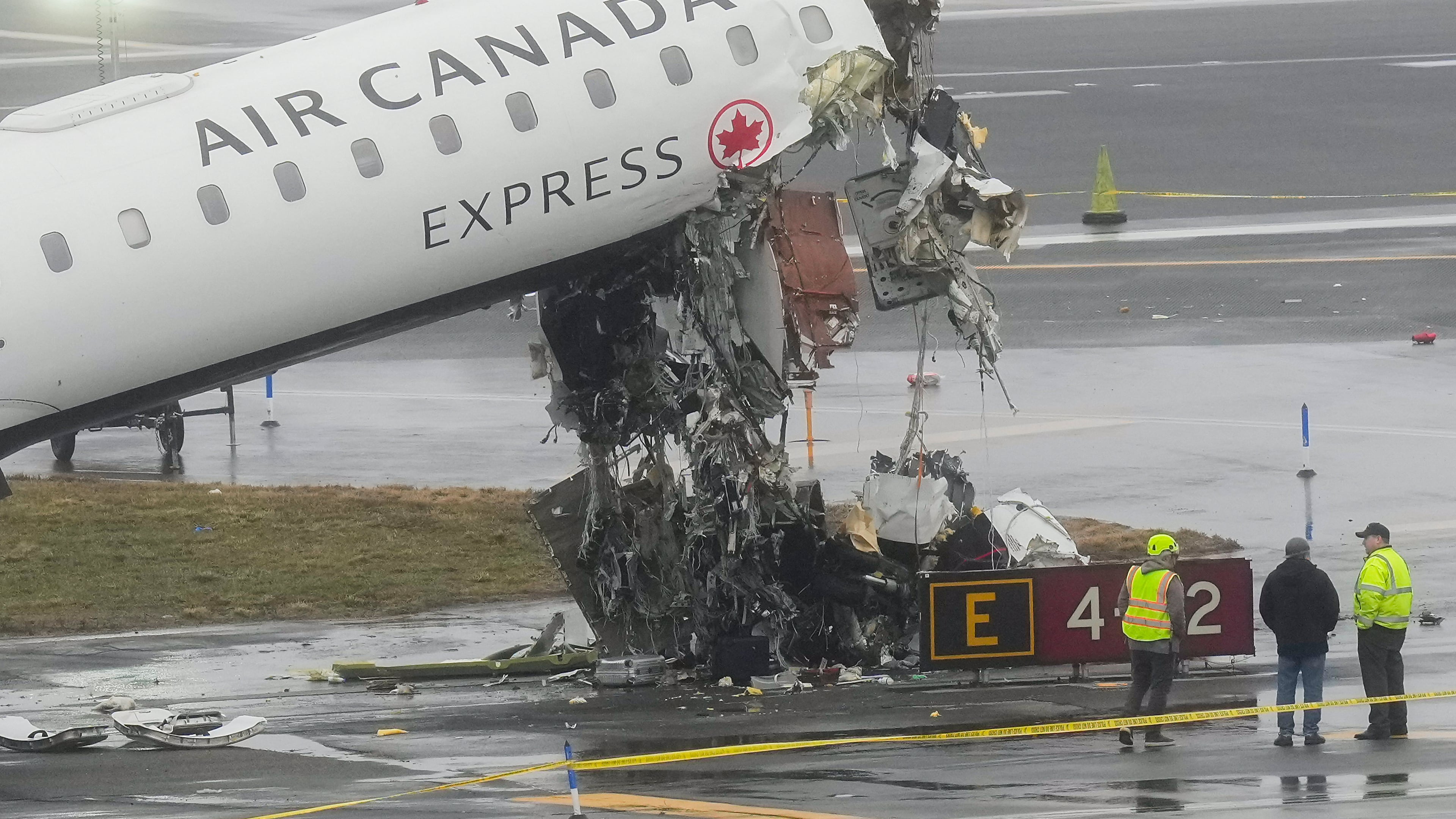
NEW YORK (AP) — A firefighter whose truck collided with an Air Canada Express jet last month on a runway at New York's LaGuardia Airport, killing both pilots, heard an air traffic controller warn “stop, stop, stop” but didn't know who it was for, federal investigators said Thursday.
Just seconds earlier, the controller had cleared the fire truck to cross the runway, but the truck started moving while warning lights that act as a stop sign for crossing traffic were still lit, the National Transportation Safety Board said in a preliminary report on the March 22 crash.
Because the truck lacked a transponder, a surface monitoring system in the control tower was unable to reliably determine its position, “did not predict a potential conflict” with the landing plane and did not generate an audio or visual alert, the report said, pointing to a series of failures that contributed to the crash.
“There were so many opportunities where this accident could have been prevented,” aviation safety expert Jeff Guzzetti said after reviewing the report.
In addition to the control tower and truck driver, he said the report suggests the pilots had a chance to recognize the danger and pull up. But, he said, they may have been too dialed into landing.
After the air traffic controller's initial stop warning, the fire truck's turret operator heard the controller say, “Truck 1, stop, stop, stop,” and realized he was telling the truck to halt, the report said. By then, the truck was already on the runway as Air Canada Express Flight 8646 was landing and speeding toward it.
Aviation safety consultant John Cox, CEO of Safety Operating Systems, said it might be understandable that the truck driver didn't recognize the first “stop” call was meant for him because the controller had just been directing a plane on a taxiway and didn't say Truck 1 at the start of the command.
The turret operator, one of two crew members in the fire truck, told investigators that as the vehicle turned left, he saw the airplane’s lights on the runway, the report said. The plane registered a speed of 104 mph (167 kph) just before the collision. The truck was going about 30 mph (48 kph).
The fire truck was leading a convoy of vehicles, including four fire trucks, a police car and a stair truck, responding to an emergency involving a strong odor that was making flight attendants feel ill aboard a departing United Airlines jet.
The air traffic controller cleared the truck to cross the runway just 12 seconds before the plane touched down, investigators said. About eight seconds later, the controller frantically began calling for the truck to stop.
Pilots killed, 39 people hurt, including fire crew members
The plane, a CRJ900 regional jet from Montreal, was carrying 76 people. Pilots Antoine Forest, 30, and Mackenzie Gunther, 24, were killed. It was the first deadly crash at LaGuardia in 34 years.
In addition, 39 people were taken to hospitals, including six described as seriously injured. The two fire truck crew members are recovering at home after being released from the hospital, according to the Port Authority of New York and New Jersey, which operates LaGuardia.
A flight attendant still strapped in her seat survived after being thrown onto the tarmac.
Another flight attendant reported taking his seat in the rear of the plane for landing and described the flight as normal until he felt an impact, the report said. He didn't know what had happened and attempted to call the pilots but received no response, the report said.
The Port Authority said it is conducting a comprehensive review of the NTSB's initial findings. “Our focus is straightforward: ensure our safety procedures and protocols are as strong as they can be and take action to strengthen them as needed,” the agency said.
LaGuardia was busier than usual the night of the crash because flight delays pushed the number of arrivals and departures after 10 p.m. to more than double what was scheduled, according to aviation analytics firm Cirium. Two air traffic controllers were on duty, consistent with normal scheduling, the report said.
Planes were landing every few minutes, with a dozen flights arriving between 11 p.m. and when the crash happened less than 40 minutes later. At the same time, the controllers had to shuffle their duties because of the odor issue on the United plane.
While the more senior controller coordinated the United emergency response, the other controller took over directing vehicles on the ground while continuing to authorize takeoffs and landings.
“These controllers were just way busy, just too busy,” Guzzetti said.
Airport had technology designed to prevent crashes
The warning lights — known as runway entrance lights — were lit until the fire truck reached the edge of the runway, about three seconds before the collision, the report said. By design, they turn off two or three seconds before a plane reaches a runway intersection, the report said.
The runway warning lights in place at 20 of the nation’s busiest airports are one of the backup systems designed to help prevent a crash. Cox said the truck should have never entered the runway while the warning lights were illuminated.
“That’s an automated system so even though the controller says you’re cleared to cross, the lights mean that there’s an airplane that is either on the runway or about to be,” Cox said. “So the truck driver is going to have some questions to answer there.”
LaGuardia is one of 35 major U.S. airports with an advanced surface surveillance system that combines radar data with information from transponders inside planes and ground vehicles to help prevent runway incursions. Controllers have a display in the tower that’s supposed to show the location of every plane and vehicle.
The system, known as ASDE-X, didn’t sound an alarm partly because the radar had trouble distinguishing the closely spaced trucks and the radar targets intermittently merged on the display. Only two targets were displayed just before the crash, even though there were seven vehicles. None were equipped with transponders that would have helped the system to precisely track their movements.
According to air traffic control transmissions, Flight 8646 was cleared to land on Runway 4 at 11:35 p.m.
About two minutes later — and 25 seconds before the crash — the fire crew asked to cross the same runway, which was between the airport’s fire station and where the United Airlines jet had parked.
Five seconds later, with Flight 8646 approaching the runway a little more than 100 feet (30 meters) above the ground, an air traffic controller cleared the fire truck to cross.
Then, just nine seconds before the crash, the controller frantically told the fire crew: “Stop, stop, stop, stop. Truck 1. Stop, stop, stop, stop.” A second later, the plane’s landing gear touched down.
___
Funk reported from Omaha, Nebraska. ___
This story has been corrected to show that pilot Antoine Forest was 30, not 24; and pilot Mackenzie Gunther was 24, not 30.