US and Iran agree to 2-week ceasefire as Trump seizes diplomatic offramp

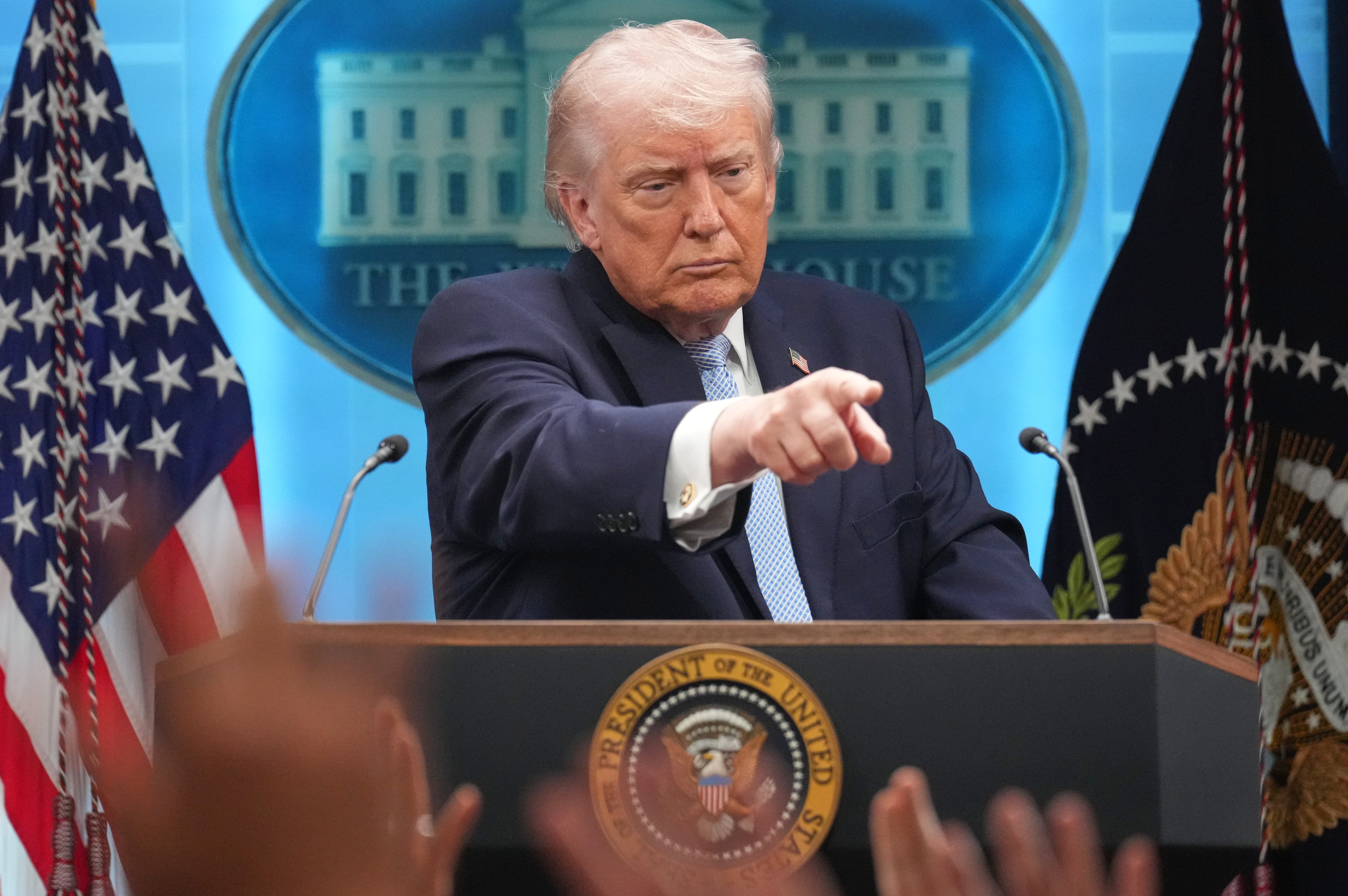
TEHRAN, Iran (AP) — U.S. President Donald Trump pulled back on his threats to launch devastating strikes on Iran late Tuesday, swerving to deescalate the war less than two hours before the deadline he set for Tehran to capitulate or face a major escalation.
Trump said he was holding off on his threatened attacks on Iranian bridges, power plants and other civilian targets as the U.S. and Iran agreed to a two-week ceasefire that includes the reopening of the Strait of Hormuz. He said Iran has proposed a “workable” 10-point peace plan that could help end the war launched by the U.S. and Israel in February.
Iran’s Supreme National Security Council said it has accepted the ceasefire and that it would negotiate with the United States in Islamabad beginning Friday. Neither Iran nor the United States said when the ceasefire would begin.
Iranian Foreign Minister Abbas Araghchi said passage through the strait would be allowed under Iranian military management. It wasn’t immediately clear whether that meant Iran would loosen its chokehold on the waterway.
The plan includes allowing both Iran and Oman to charge fees on ships transiting through the Strait of Hormuz, the narrow mouth of the Persian Gulf, a regional official said Wednesday. The official said Iran would use the money it raised for reconstruction.
In addition to control of the strait, Iran’s demands for ending the war include withdrawal of U.S. combat forces from the region, the lifting of sanctions and the release of its frozen assets.
Even as the ceasefire was announced, missile alerts continued in the United Arab Emirates, Israel, Saudi Arabia, Bahrain and Kuwait early Wednesday, hinting at the chaos surrounding the diplomatic moves. A gas processing facility in Abu Dhabi was ablaze after incoming Iranian fire, officials said.
The U.S. military has halted all offensive operations against Iran but continues defensive actions, said an official, who spoke on condition of anonymity to describe sensitive military operations.
Since the war began, Trump has repeatedly backed off deadlines just before they expire.
In doing so again Tuesday, Trump said in a social media post he had come to the decision “based on conversations” with Pakistan Prime Minister Shehbaz Sharif and Gen. Asim Munir, Pakistan’s powerful army chief. Sharif, in a post on X hours earlier, urged Trump to extend his deadline by two weeks to allow diplomacy to advance. He used the same post to ask Iran to open the strait for two weeks.
“Almost all of the various points of past contention have been agreed to between the United States and Iran, but a two week period will allow the Agreement to be finalized and consummated,” Trump said.
Israel has also agreed to the ceasefire, according to a White House official who was not authorized to comment publicly and spoke on condition of anonymity. And Sharif said the ceasefire extends to Israel and Hezbollah halting fighting in Lebanon.
But there are concerns in Israel about the agreement, according to a person familiar with the situation who spoke on condition of anonymity because they were not allowed to speak to the media. The person said Israel would like to achieve more.
Iran’s stockpile of highly enriched uranium is still buried at enrichment sites. The program had been one of the main issues cited by both Israel and the U.S. in launching the war.
Earlier Trump threats raised alarms
Trump’s expansive threat Tuesday did not seem to account for potential harm to civilians, prompting Democrats in Congress, some United Nations officials and scholars in military law to say such strikes would violate international law.
Tehran’s representative at the U.N., Amir-Saeid Iravani, said the threats “constitute incitement to war crimes and potentially genocide” and that Iran would "take immediate and proportionate reciprocal measures” if Trump launches devastating strikes.
The U.S. and Israel have battered Iran with attacks targeting its military capabilities, leadership and nuclear program. Iran has responded with a stream of strikes on Israel and Gulf Arab neighbors, causing regional chaos and outsized economic and political shock.
Late Tuesday, Pakistan's prime minister urged Trump to extend his deadline by two weeks to allow diplomacy to advance. In a post on X, Shehbaz Sharif, whose country has been leading negotiations, also asked Iran to open up for two weeks the Strait of Hormuz.
Before the deadline, airstrikes hit two bridges and a train station, and the U.S. hit military infrastructure on Kharg Island, a key hub for Iranian oil production.
While Iran cannot match the sophistication of U.S. and Israeli weaponry or their dominance in the air, its chokehold on the strait since the war began in late February is roiling the world economy and raising the pressure on Trump both at home and abroad to find a way out of the standoff.
Trump keeps an off-ramp open
“A whole civilization will die tonight, never to be brought back again,” if a deal isn’t reached, Trump said in an online post Tuesday morning. But he also seemed to keep open the possibility of an off-ramp, saying that “maybe something revolutionarily wonderful can happen.”
Earlier, Iranian official Alireza Rahimi issued a video message calling on “all young people, athletes, artists, students and university students and their professors” to form human chains around power plants.
Iranians have formed human chains in the past around nuclear sites at times of heightened tensions with the West. State media posted videos online that showed hundreds of flag-waving people massed at two bridges and at a power plant hundreds of kilometers (miles) from Tehran, though it was not clear how widespread the practice was.
“They’re not allowed to do that,” Trump said in a phone call with NBC News.
A general in Iran's Revolutionary Guard general warned that Iran would “deprive the U.S. and its allies of the region’s oil and gas for years” and expand its attacks across the Gulf region if Trump carries out his threat.
In Tehran, the mood was bleak. A young teacher said that many opponents of Iran's Islamic system had hoped Trump's attacks would quickly topple it. As the war drags on, she fears U.S. and Israeli strikes will spread chaos.
“If we don’t have the internet, and if we don’t have electricity, water, and gas, we’re really going back to the Stone Age, as Trump said,” she told The Associated Press, speaking on the condition of anonymity for her safety.
Airstrikes hit Iran, which fires on Saudi Arabia and Israel
Intense airstrikes pounded Tehran, including in residential neighborhoods. In the past, such strikes have targeted Iranian government and security officials.
The Israeli military said it attacked an Iranian petrochemical site in Shiraz, the second day in a row it hit such a facility. The military later said it also struck bridges in several cities that were being used by Iranian forces to transport weapons and military equipment.
A U.S. official, who spoke on condition of anonymity to discuss sensitive military operations, described the strikes on Kharg Island as hitting targets previously struck and not directed at oil infrastructure.
Saudi Arabia said it intercepted seven ballistic missiles and four drones launched by Iran. Iran also fired on Israel.
More than 1,900 people have been killed in Iran since the war began, but the government has not updated the toll for days.
In Lebanon, where Israel is fighting Iran-backed Hezbollah militants, more than 1,500 people have been killed. and more than 1 million people have been displaced. Eleven Israeli soldiers have died there.
In Gulf Arab states and the occupied West Bank, more than two dozen people have died, while 23 have been reported dead in Israel, and 13 U.S. service members have been killed.
___
Gambrell reported from Dubai, United Arab Emirates. Magdy reported from Cairo. Associated Press writers John Leicester in Paris; Nicole Winfield in Rome; Amir-Hussein Radjy in Cairo; Natalie Melzer in Jerusalem; Farnoush Amiri at The United Nations; and Konstantin Toropin, Seung Min Kim, Michelle L. Price, Joshua Boak and Will Weissert in Washington contributed to this report.