Vance warns Iran not to 'play' the US as he departs for negotiations aimed at ending the war
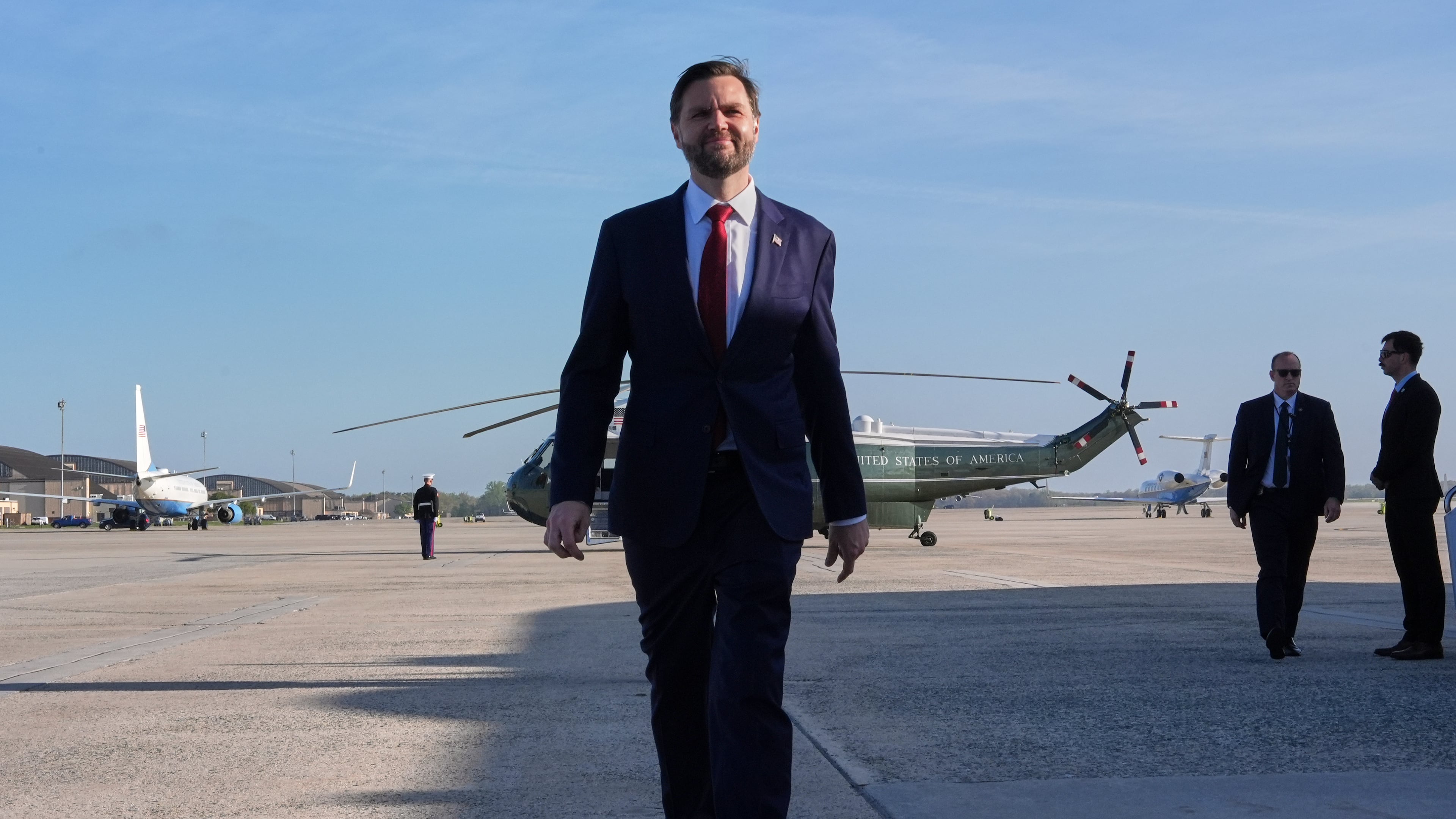
WASHINGTON (AP) — Vice President JD Vance on Friday warned Iran not to “play” the U.S. as he headed overseas for negotiations aimed at ending the war.
President Donald Trump has tasked the member of his inner circle who has seemed to be the most reluctant defender of the 6-week-old conflict with Iran to now find a resolution and stave off the U.S. president's astonishing threat to wipe out its “whole civilization.”
Vance, who has long been skeptical of foreign military interventions and outspoken about the prospect of sending troops into open-ended conflicts, set off Friday to lead mediated talks with Iran in the Pakistani capital of Islamabad.
“If the Iranians are willing to negotiate in good faith, we’re certainly willing to extend the open hand,” Vance told reporters before boarding Air Force Two to make his way to the talks in Pakistan. But he added, “If they’re gonna try and play us, then they’re gonna find that the negotiating team is not that receptive.”
Vance also said that Trump “gave us some pretty clear guidelines” on how talks should go, but he didn’t elaborate. He did not take questions from reporters traveling with him.
Vance's trip comes as a tenuous, temporary ceasefire appears to be on the precipice of collapsing. The chasm between Iran’s public demands and those from the U.S. and its partner Israel seems irreconcilable. And in the U.S., where Vance might ask voters in two years’ time to make him the next president, there is growing political and economic pressure to wrap it up.
As Vance made his way to the Pakistani capital of Islamabad, Iran's parliament speaker Mohammad Bagher Qalibaf said in a social media post that a ceasefire in Lebanon, where Israel is targeting Iran-backed Hezbollah militants, and the release of blocked Iranian assets “must be fulfilled before negotiations begin.” He did not elaborate further.
Iran has not yet said who it will send to the ceasefire talks in Pakistan that are expected to start Saturday.
Pakistani Prime Minister Shehbaz Sharif in a televised address to his nation Friday described the talks as a “make-or-break moment" for the two sides.
Vance is joined by Trump's special envoy Steve Witkoff and Trump's son-in-law Jared Kushner, who took part in three rounds of indirect talks with Iranian negotiators aimed at settling U.S. concerns about Tehran’s nuclear and ballistic weapons programs and its support for armed proxy groups in the Middle East before Trump and Israel launched the war against Iran on Feb. 28.
The White House has provided scant detail about the format of the talks — whether they will be direct or indirect — and has not provided specific expectations for the meeting.
But the arrival of Vance for negotiations marks a rare moment of high-level U.S. government engagement with the Iranian government. Since the Islamic Revolution in 1979, the most direct contact had been when President Barack Obama, a Democrat, in September 2013 called newly elected Iranian President Hassan Rouhani to discuss Iran’s nuclear program.
The 2 sides face a steep climb in making headway
Almost immediately after the White House and Iran announced a temporary ceasefire Tuesday evening, the sides found themselves at odds over terms of the truce.
Iran insisted that an end to the Israeli war in Lebanon was part of the ceasefire. But Israeli Prime Minister Benjamin Netanyahu and Trump said the truce did not cover Lebanon, and the Israeli operations there continued.
The U.S., meanwhile, demanded that Iran make good on reopening the Strait of Hormuz. The Islamic Republic had closed the critical shipping waterway in response to Israel’s intensifying attacks against the Hezbollah militant group in Lebanon.
“The Iranians don’t seem to realize they have no cards, other than a short term extortion of the World by using International Waterways,” Trump posted on social media on Friday. “The only reason they are alive today is to negotiate!”
Iran’s effective shuttering of the waterway has had a major impact on the U.S. and global economies. In the United States, consumer prices rose 3.3% in March from a year earlier, the Labor Department reported Friday. The largest monthly jump in gas prices in six decades spurred the sharp spike in inflation.
High stakes for peace — and for politics
It’s the highest-stakes moment thus far for Vance, who spent much of last year as more of a background player in the Trump White House, especially as others like Elon Musk and Secretary of State Marco Rubio took turns as ever-present advisers for the president.
But Vance’s portfolio is fattening fast, first with a mission to root out fraud in government programs at home and now to help solve a U.S. war in the Middle East, where complicated doesn’t even begin to describe things.
Vance, who served in the Iraq War while in the Marines and spent two years as a U.S. senator for Ohio and a little more than one as vice president, has little diplomatic experience.
On Wednesday, he dismissed speculation that the Iranians requested that he join the talks, telling reporters: “I don’t know that. I would be surprised if that was true. But, you know, I wanted to be involved because I thought I could make a difference.”
Jonathan Schanzer, a former Treasury Department official who is now executive director of the Foundation for Defense of Democracies, a hawkish Washington think tank, said Vance, with little experience on Iran policy, is an interesting choice to lead the delegation.
Trump has noted his vice president was “less enthusiastic” than other top senior officials in the Republican administration, making Vance an intriguing interlocutor for the Iranian side, Schanzer said.
“I think they probably prefer him knowing that his perspective on foreign intervention is one of skepticism,” Schanzer said of the Iranians. “I do think that he’s going to need some help. I don’t think he’s ever been engaged in negotiations with this kind of weight, this kind of seriousness. This is as serious as it gets.”
The White House has pushed back against the characterization that Iran wanted Vance in the talks, casting it as an effort to hurt negotiations.
The White House has not detailed who will be in the talks besides Vance, Witkoff and Kushner, but White House spokeswoman Anna Kelly said officials from the National Security Council, the State Department and the Pentagon “will also play a supportive role.”
During early rounds of indirect nuclear talks with the Iranians before the war, Democrats and some nuclear experts questioned whether Kushner and Witkoff had enough technical knowledge. The White House has not said whether the pair, whom Trump has entrusted with some of his most difficult negotiations since returning to office, had a nuclear expert with them for those talks.
Negotiating peace is a tall order for any vice president
Vance and Rubio are seen as the Republican Party’s strongest potential 2028 presidential contenders, though neither has given a clear answer about whether he intends to run.
As vice president, Vance inherently would carry any baggage of the administration if he eventually runs for president, said Joel Goldstein, a professor of law at Saint Louis University, who is an expert on the history of the vice presidency. But stepping in to lead negotiations even further identifies him with the conflict.
“The fact that he’s involved in the negotiations in a very visible way, that means that, if things go south, that people will be pointing fingers at him,” Goldstein said.
He added, “If things go well, then it will be something that he could point to.”
—
AP writer Munir Ahmed in Islamabad, Pakistan, contributed reporting.


