Asian shares decline and oil prices up more than $1 after US strikes on Iran
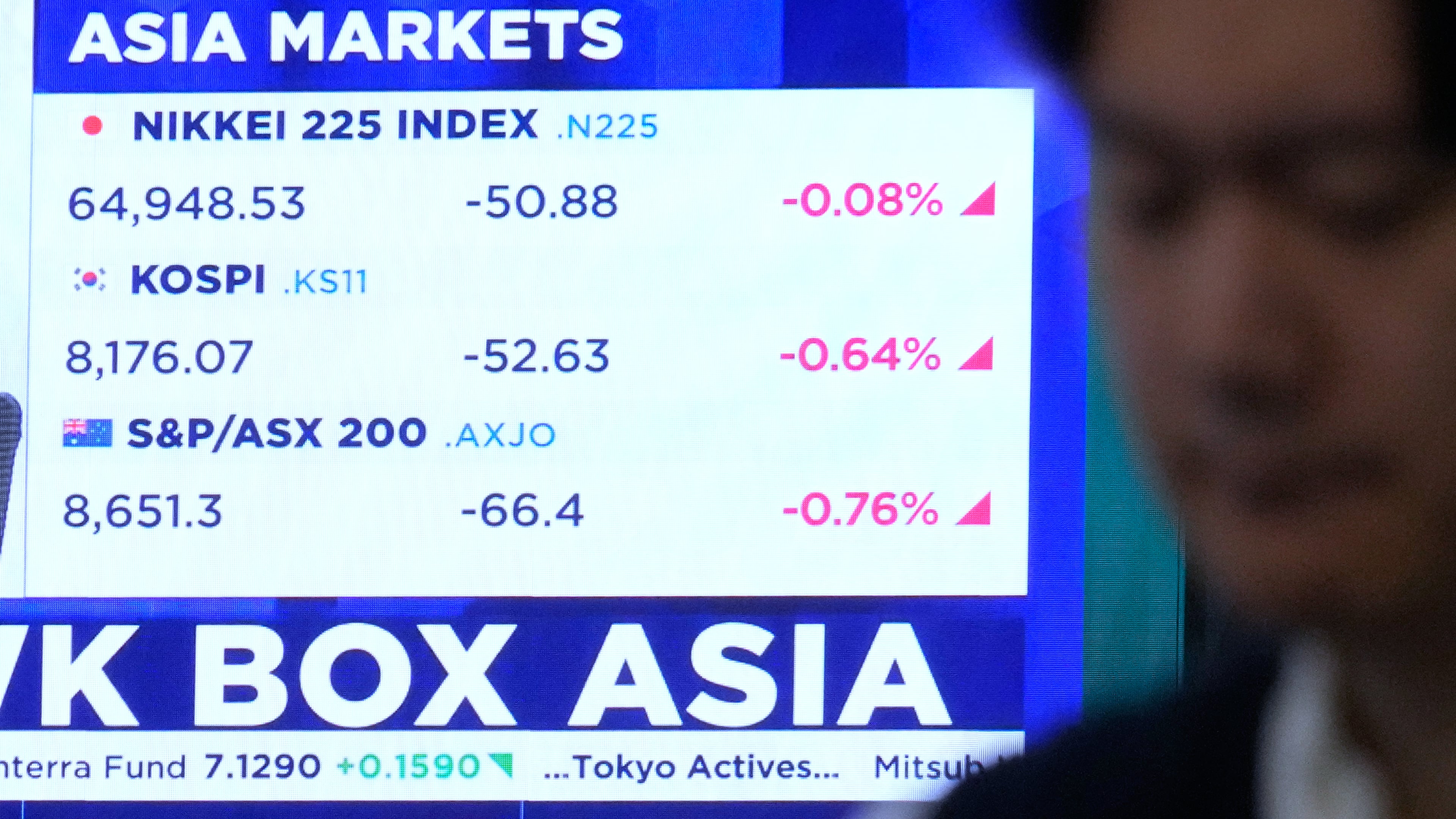
Asian shares declined Thursday following more of what the U.S. military said were defensive strikes against Iran.
Oil prices gained more than $2 a barrel after having dropped sharply a day before. U.S. futures inched lower.
U.S. officials said Central Command forces shot down four Iranian one-way attack drones that posed a threat near the Strait of Hormuz. The U.S. military also hit an Iranian ground control station in Bandar Abbas that was about to launch a fifth drone. Those attacks followed others earlier in the week.
Meanwhile, President Donald Trump asserted that Iran is “negotiating on fumes” and said November’s midterm elections in the United States won’t make him rush into a deal to end the nearly three-month-old conflict.
In early Asian trading, Japan's Nikkei 225 lost 0.4% to 64,711.12, while the Kospi in South Korea lost 0.4% to 8,192.66.
Hong Kong's Hang Seng index shed 1.4% to 24,983.64, while the Shanghai Composite index edged 0.1% higher to 4,098.10.
In Australia, the S&P/ASX 200 declined 1.4% to 8,594.10, while Taiwan's Taiex dropped 1.4%.
“Conflicting reports on the contours of a U.S.-Iran deal dampened risks sentiments as markets grow increasingly wary about the possibility of a deal,” Tan Boon Heng of Mizuho Bank in Singapore said in a commentary.
“While there is desire to maintain the ceasefire with both Iran and (asterisk)the) U.S. toning down language on renewed attacks and persisting with indirect channels of communication, it remains remarkably hard to envisage how a compromise can be reached on key issues,” he said.
On Wednesday, U.S. stocks inched to more records after oil prices declined more than 4%, easing pressure on consumers and businesses worldwide.
The S&P 500 edged up by less than 0.1% to 7,520.36 and the Dow Jones Industrial Average rose 0.4%, to 50,644.28. The Nasdaq composite gained 0.1% to 26,674.73. All three indexes set all-time highs.
Stocks of companies with big fuel bills helped lead the way on hopes that lower oil prices will remove a big drag on their profits. Norwegian Cruise Line Holdings climbed 6.1%, and United Airlines rallied 6.3%. Delta Air Lines rose 3% and set an all-time high.
The price for a barrel of Brent crude oil fell 4.6% to $92.25 after the ceasefire between the United States and Iran appeared to hold despite the U.S. military launching what it called “self-defense” strikes in southern Iran.
However, after the latest strikes, in early Thursday trading Brent was up $2.57 at $94.82 a barrel.
A barrel of benchmark U.S. crude gained $2.65 to $91.33. On Wednesday, it had fallen 5.5%, to settle at $88.68, back to where it was in mid-April.
Prices have moderated, after surging to well over $100 a barrel, on hopes that the United States and Iran can reach an agreement to reopen the Strait of Hormuz and allow oil tankers to exit the Persian Gulf for deliveries again.
Stocks have been able to run to records despite the painful inflation and uncertainty caused by high oil prices largely because companies have reported surprisingly strong profits for the start of 2026, and the forecast is for them to continue.
In other dealings early Thursday, the U.S. dollar rose to 159.52 Japanese yen from 159.51 yen. The euro slipped to $1.1608 from $1.1626.