In a city with an iconic skyline, the Obama presidential museum aims to reshape Chicago architecture
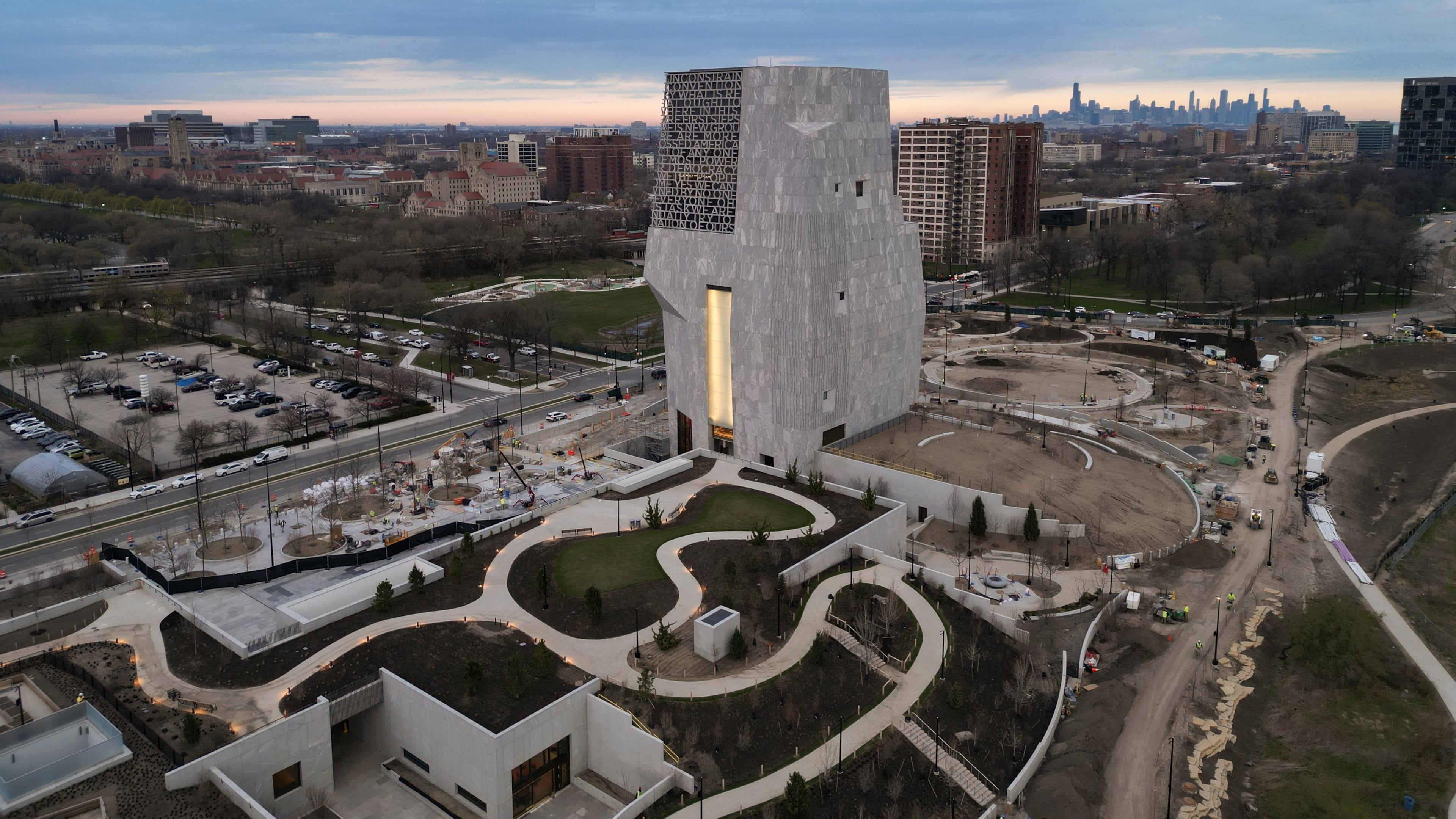
CHICAGO (AP) — The granite monolith soars above a leafy stretch of Chicago’s South Side, a nearly windowless exterior more suited to a sci-fi film set than the state-of-the art presidential museum held within.
Crews are putting the finishing touches on the Obama Presidential Center ahead of the official public opening on Juneteenth, more than a decade after the site was chosen. But the design of the roughly $850 million campus — particularly the conspicuous 225-foot high rise at its north end — still divides the city celebrated as the birthplace of the modern skyscraper.
For some, it’s a jarring choice in Barack Obama’s hometown after a grueling battle over its location in a lakefront park where classical style buildings are more common. To others, it’s a bold addition that will shape Chicago’s iconic skyline for decades to come.
Residents have compared it to a grain elevator, ship from “Star Wars” and a mausoleum.
“It doesn’t fit in at all,” said Brenda Nelms, who has lived in the area since the 1970s and leads a group that advocates for nearby Jackson Park, which spans more than 500 acres.
Leaders of the Obama Foundation, which has raised private funds, say they’ve heard it all. They enlisted “Star Wars” actor Mark Hamill for cheeky promotional videos on May the 4th, a day celebrated by fans of the movie franchise.
“Part of the joy of the center is everyone is going to have their unique experience,” said Valerie Jarrett, foundation CEO and a former Obama advisor. “The design of the building was intended to be inviting and opening to people whether they live across the street or around the world.”
Chicago’s architecture is ‘spectator sport’
The bar for architectural design is high in Chicago, from Louis Sullivan’s modern skyscrapers after the Great Chicago Fire of 1871 to Helmut Jahn’s post-modern office buildings.
Discourse around design is so fierce in the nation’s third-largest city that Chicago Sun-Times architecture critic Lee Bey calls it “a spectator sport.” His initial impression of the Obama Presidential Center was that it looked more suited to a cemetery.
The striking design has few windows, all selectively placed. Foundation officials say that decision also helps protect the artifacts inside from sunlight, including an Oval Office replica.
Bey said the museum design makes more sense in context with the other low-lying buildings on the campus, which includes a basketball court, children’s playground, public library branch and works by prominent artists.
Mixed public response has greeted other renown Chicago buildings, he said. The former John Hancock Center, a black 100-story building marked by giant X’s, was compared to an oil rig soon after it was built in the 1960s. Renamed 875 North Michigan Avenue in recent years for its address, the building houses stores, condos and offices.
“As we begin to experience buildings, we begin to imprint our own impressions,” Bey said. “The John Hancock becomes less of an oil derrick and more of the building that has your doctor’s office.”
Edward Keegan, a Chicago Tribune architecture columnist, has called the presidential museum “an un-Chicago building” because of the few windows and unusual shape. Still, it offers a unique perspective of the city.
Atop the building is a glass-enclosed “Sky Room,” with panoramic views of Chicago, including north-facing perspectives of downtown, which are uncommon from that height.
“It doesn’t feel like any other place in Chicago,” he said. “It does feel unique and unexpected.”
After fights over the location, some worry about future
The road to the museum was bumpy, even though support for Obama has remained vigorous in the Democratic stronghold.
Lawsuits to stop construction started after its location was announced in 2015. Concerns about displacement of low-income and Black residents living in pockets near the museum grew. Community groups lobbied for housing protections, but area residents say they don’t go far enough as prices for homes near the museum have soared.
Construction of the museum involved tearing up nearly 20 acres of park land and scrapping a section of major thoroughfare, which residents say was critical to connect residents from other parts of the city and suburbs with downtown.
On a recent walk through a bird sanctuary near the center, activist Robin Kaufman, 82, said she couldn't fully enjoy the wildflowers by the secluded ponds as she once did. She watched as ducks paddled through a lagoon but couldn't ignore the center's tower poking out above the tree line.
“Everywhere I go, you can see it, so you’re reminded of what’s going on and that’s distressing,” she said. “I’m very distrustful of anything they say.”
She and others have anxiety about what else might come to the area because of Obama's presidential center.
“It’s a Trojan horse,” said Shannon Bennett with the Kenwood Oakland Community Organization. “It’s an extreme version of a scheme to transform these communities for another population.”
Obama advisor says facility outweighs costs
Several design choices were made by the former president with New York-based architects, Tod Williams and Billie Tsien. Obama chose a stone design and wanted a high tower for city views not far from where he raised his family and taught law at the University of Chicago.
The tower’s design is meant to depict four hands coming together in solidarity. Wrapped around one side are 5-foot concrete capital letters, an excerpt of Obama’s 2015 speech commemorating the 50th anniversary of the Selma-to-Montgomery march. It begins, “You are America.”
The Obama Foundation said they have widened some roads, added a new field to the area that local schools use and the campus has a new public library branch, basketball gym for community use, a playground and gardens that have been landscaped to blend in with the park around it.
“The benefit of having this extraordinary facility far outweighs any costs,” Jarrett said. “It’s a symbol to the community of how important they are to us.”
Adam Rubin at the Chicago Architecture Center called it a successful project so far, but added that questions linger about whether the tradeoff of park land for the center was worth it.
“It really does have a sense of place,” he said of the museum. “Time will tell how people utilize it.”