New Black Wall Street Market failed. But there’s hope its mission won’t.

Though signs of its impending closure were all around this past weekend, the New Black Wall Street Market was having one last hurrah.
On Saturday, during what was termed the “Customer Appreciation Blowout Sale,” a DJ played oldies while thanking shoppers for coming by the Stonecrest bazaar and pointing out the free cupcakes. A giant black, gold and white balloon arch stood next to the Pink Lion Jazz Club ahead of its farewell show later that night.
Most of the few remaining vendors were concentrated near the front hallway inside the cavernous structure 20 miles southeast of Atlanta selling wares at steep markdowns. It was one last glimpse at the excitement that encircled the market when it first opened less than five years ago, aiming to elevate Black- and minority-owned small businesses.
“Just the energy, the concept, you know, the support that we were getting while we were there,” said Kimberly Greene, founder of blackB4U, about the initial months of the market. She was one of the few remaining vendors this weekend. “We were like, ‘This is the ideal place.’”

But venturing further into the market now, most of the vendor booths in the rest of 125,000-square-foot building were empty, with baseboards missing and holes in the drywall from wall hangings that had been removed. Out front, people loaded a trailer with office furniture and signs.
It’s a bittersweet fate for an ambitious idea that aimed to deliver development dreams that have long eluded this corner of south DeKalb County. Now, as the New Black Wall Street Market prepares to permanently close Thursday, vendors and local officials are mourning what could have been.
“It was a noble undertaking that never reached its full potential,” DeKalb CEO Lorraine Cochran-Johnson said.
The death of the founder
The market opened in late 2021 to fanfare and high hopes. It was the brainchild of Lecester “Bill” Allen, an entrepreneur and philanthropist turned developer who died in 2024.
Years ago, he proposed turning a vacant Target store into a thriving marketplace where more than 100 Black entrepreneurs could sell their wares, and branded it as a modern take on a historic Black business district. Allen said the market would be the first phase of an ambitious $700 million development along I-20 in the heart of south DeKalb.
He modeled his idea after the historic Greenwood community of Tulsa, Oklahoma, known as Black Wall Street, that was burned down in the 1921 Tulsa Race Massacre by a white mob that killed dozens of Black residents and displaced a thriving community.

When the market first opened, nearly all of its 118 vendor spots were rented. But that steadily dwindled.
Onethia Flowers, the market’s general manager, told The Atlanta Journal-Constitution there were about 30 vendors at the beginning of this year.
Greene, who sells officially licensed Negro leagues, Buffalo Soldiers and Tuskegee Airmen apparel, said the market drew her from New Jersey in 2022.
“We came down just as a pop-up, and our plan was to be here for like two weeks. And people liked us. So we said, ‘Well, we’ll stay a couple more weeks.’ And then a store opened up, and then a house opened up, and now we live in Georgia,” Greene said.
For most of that first year, the market was busy on weekdays and on weekends, Greene said. Then it started to slow, particularly during the work week.
Then at the beginning of 2023, she said things declined further and that was “when we started having conversations because advertising stopped, and our biggest thing was, if people don’t know we’re here, they’re not going to come.”
But the market faced challenges from the onset.
Developed amid the COVID-19 pandemic, its Labor Day 2021 grand opening was delayed two months, leaders of the market said, because of an uptick in infections in south DeKalb. Reports of a leaky roof, combative management and scorned former tenants tarnished its first year.
Greene said that the lack of restaurant options in the market also kept it from reaching its full potential.
“When people come, they want to be able to eat,” she said. “And that was one of the things that at every meeting we kept saying, ‘You know, well, when is the food going to come?’”
Matt Hampton was Allen’s longtime business representative, assisting with his real estate holdings and operating the Allen Entrepreneurial Institute until about six months ago. He was also the New Black Wall Street Market’s director when it opened.
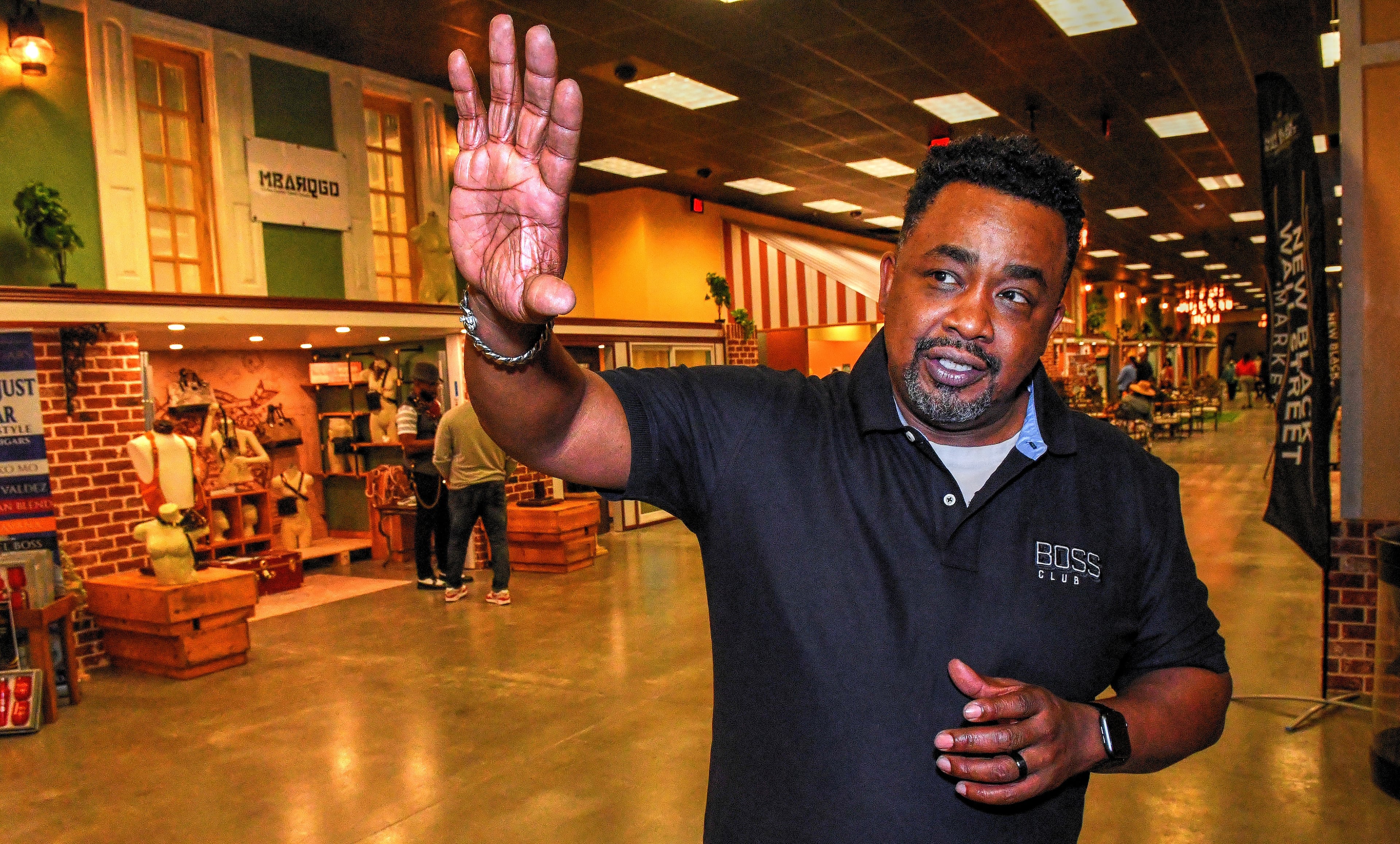
The market attracted 10,000 shoppers during its first weekend, but Hampton said the market’s early successes couldn’t survive Allen’s death from a prolonged illness in 2024.
“You didn’t have his leadership or his presence. You didn’t have him as a North Star for all of us,” Hampton told the AJC. “It definitely had a gradual decline, and it’s unfortunate because I think it was a great model.”
Big tax breaks, little to show
Allen was the largest commercial property owner in Stonecrest, and he leveraged those real estate holdings and political connections with city leadership to kickstart ambitious development plans.
Allen was a supporter of Stonecrest’s cityhood movement in 2016, an effort that aimed to bring economic development to a part of the county hit hard nearly 20 years ago by the financial crisis.
Cochran-Johnson, who is also a Stonecrest resident, said the area has been historically overlooked for large development projects despite being one of the country’s largest pockets of Black wealth.
“Even though the wealth is present, until the density is there, it’s difficult to recruit and bring forth many of the businesses that the community desires,” Cochran-Johnson said.
Stonecrest’s first generation of leaders made changing that a top priority, although the effort was plagued by issues.
In 2017, a development team proposed a $200 million sports and entertainment complex called Atlanta Sports City near the Mall at Stonecrest. The project devolved into lawsuits rather than the sports fields, shops and restaurants the developers promised.
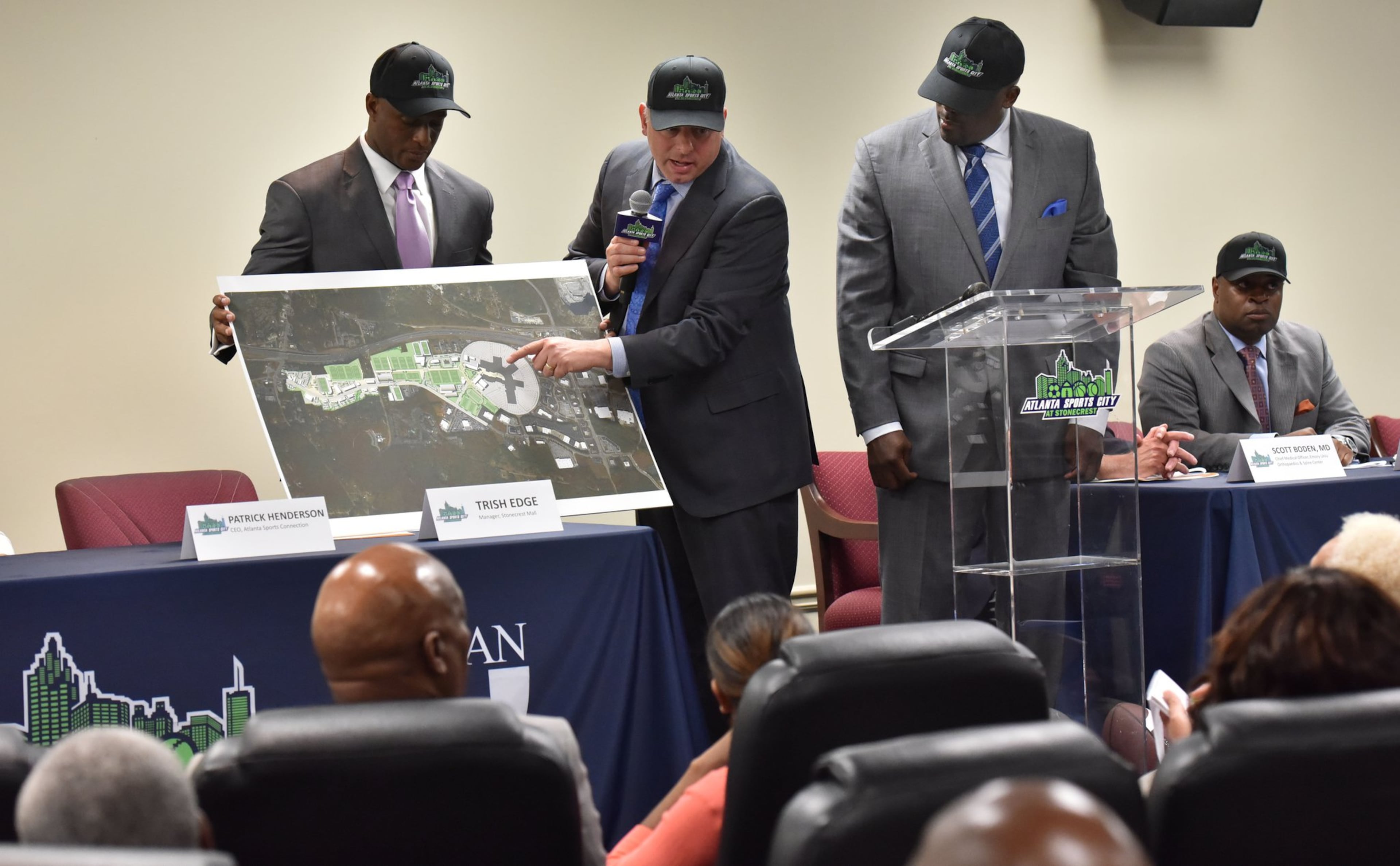
Allen, who was not involved with Atlanta Sports City, acquired much of the property and pitched his own even more ambitious plan. He envisioned a $700 million “International Village” with a 16-story hotel positioning Stonecrest as a tourism destination. The New Black Wall Street Market was supposed to be its first phase.
The Stonecrest Development Authority, a government entity that supports business recruitment and construction through tax breaks, supported the project in the only two deals it ever made.
The authority in 2019 and 2020 entered into agreements with Allen’s real estate firm, Allen Family Investments, to provide a 22-year tax break. For the first 12 years, Allen wouldn’t pay any property taxes on the 300 acres he planned to develop, and the taxes would steadily increase to market value over the latter decade. According to county property records, the land is worth roughly $30 million, and the New Black Wall Street Market is worth about $4.5 million.
Allen was an original member on the development authority’s board but stepped down about nine months before the first tax break was approved. Critics said the tax breaks were sweetheart deals, which Allen denied at the time.
Jason Lary, the founding mayor of Stonecrest who Allen supported, led the development authority during that time before he was embroiled in an unrelated scandal. Lary resigned as mayor, pleaded guilty to defrauding a federal COVID-19 relief program and spent more than two years in prison.
The Stonecrest Development Authority was left in shambles during that time, with Lary’s successors purging the remaining board members and reconstituting it in 2023. It hasn’t made a development deal since then.
An investigation by the AJC in 2022 found the authority did not have records of prior bond deals, financial statements or documents related to projects required by the Georgia Open Records Act.
Jazzmin Cobble, the current Stonecrest mayor, and the city’s economic development director, Lance Randall, declined interview requests about the future of the market, the property and the previously awarded tax breaks.
Typically, such tax abatements are able to be carried over to a new owner in the case of a sale, increasing its attractiveness for development.
“Allen did a lot of good, but the closing of the market does bring a degree of sadness because it feels like an end to his efforts,” Cochran-Johnson said.

In light of the market’s closure and with no work done on the broader mixed-use project, Cochran-Johnson encouraged developers to look at the Stonecrest site that has always fostered big dreams.
“I see a lot of people that show up that don’t have the capacity to move things forward even though they have a desire,” she said. “So we need people that have the capacity.”
‘Pick up the baton’
For Jaquatte Williams, an original vendor and CEO of J’s Gift Shoppe, the New Black Wall Street Market gave her a chance to achieve her long-held dream of having her own storefront.
Williams said Allen’s passing deeply affected the market.
“Not having someone in place to just pick up the baton and keep it moving forward,” she said. “I think that was probably one of the things that hurt us the most.”

Greene, another of the market’s vendors, said she had hoped the Allen family “would want to carry on the legacy.”
“Even though I know it took a big toll on Mr. Allen, there was a part of me that was like, well, maybe somebody will decide to come in, or somebody from the outside may want to come and just, you know, bring it back to life,” she said.
Attempts to reach Allen’s family through Hampton, his former aide, and others connected to the market, were not immediately successful.
The space’s future is now unclear. Flowers, the market’s general manager, said the Allen family is in discussions regarding the future of the building, but she was unsure if they will sell it or not.
But the market’s legacy will live on. Hampton said it inspired other Black communities across the country to explore ways to support minority businesses in novel ways.
“It failed here,” he said, “but I think it also lit a fire under people around the country to replicate it and to start a movement.”
About the Authors

Mirtha Donastorg is a reporter on The Atlanta Journal-Constitution’s business team focusing on Black wealth, entrepreneurship, and minority-owned businesses as well as innovation at Atlanta’s HBCUs.

Zachary Hansen, a Georgia native, covers economic development and commercial real estate for the AJC. He's been with the newspaper since 2018 and enjoys diving into complex stories that affect people's lives.