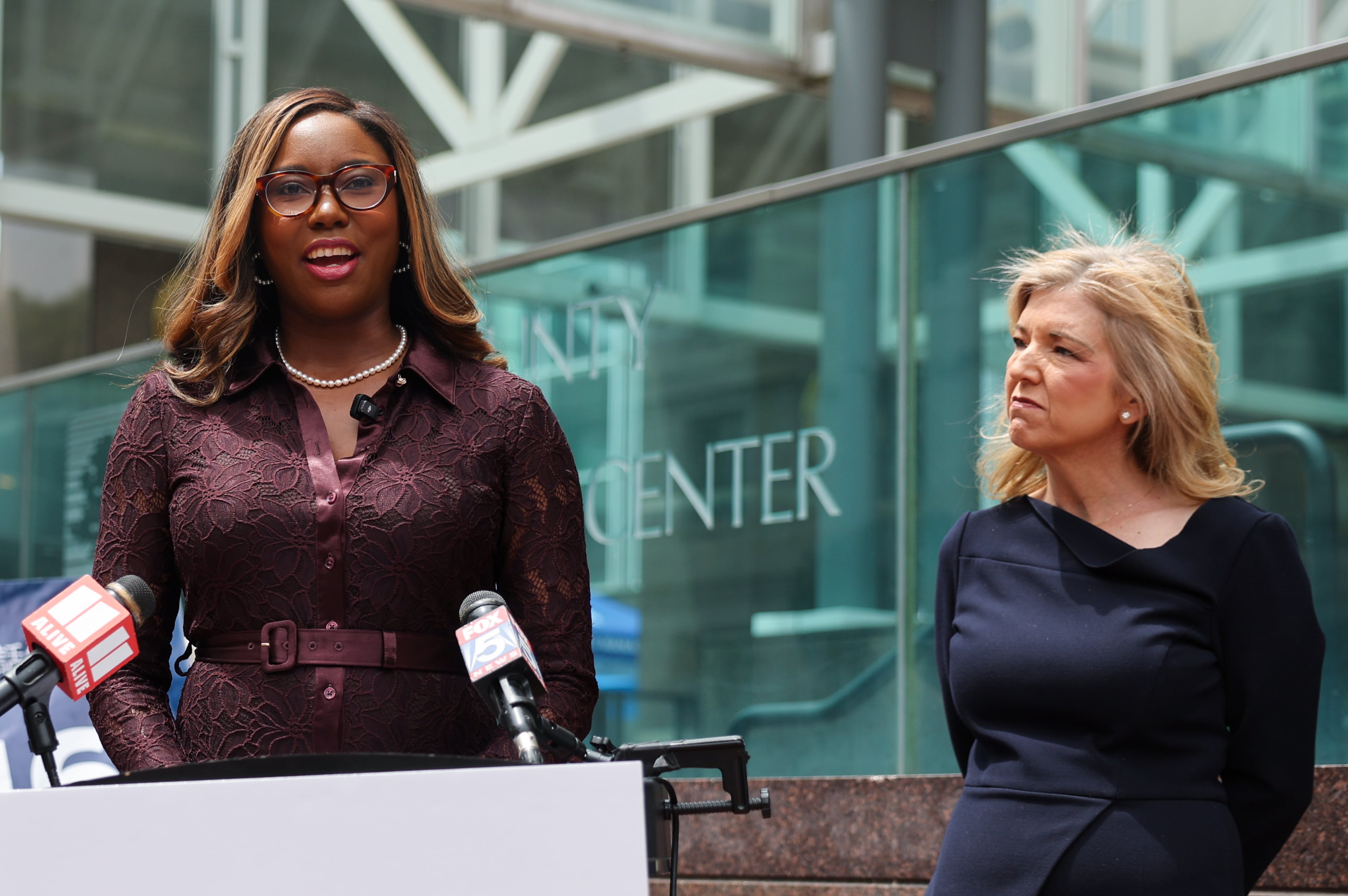
Atlanta mayor introduces scaled-back tax district extension plan

Atlanta Mayor Andre Dickens on Monday introduced a sweeping legislative package he hopes will help combat inequality and close the city’s growing wealth divide.
The most consequential piece involves renewing six of Atlanta’s eight tax allocation districts for the next three decades in an effort to leverage property tax growth into new development for historically underserved communities.
A previous proposal introduced last year would have renewed all eight of the city’s TADs — a plan with plenty of skeptics, even on the Atlanta City Council.
But the second-term mayor’s scaled-back TAD proposal still faces fierce headwinds since it requires buy-in from Atlanta’s school board and the Fulton County Commission, as well as his own City Council.
Members of both the school board and the County Commission have expressed concern over the loss of tax revenue the extensions would cause, as they face their own financial challenges.

Without approval from all three entities, it’s unclear what might become of Dickens’ Neighborhood Reinvestment Initiative — his ambitious plan to rewrite what he often refers to as Atlanta’s “tale of two cities” by investing revenue from the TAD extensions into historically underserved neighborhoods.
Also unclear is exactly how much revenue the scaled-back proposal would raise even if it were approved by all three. City leaders estimated the original plan would have brought in nearly $6 billion over the lifetime of the extensions.
On Monday, members of Dickens’ administration said they are hopeful the plan can still generate between $5 and $7 billion, even without the Beltline and Perry-Bolton TADs, which would be allowed to expire.
The lucrative Beltline TAD alone accounts for more than half of the funding generated across the eight districts. That expires in 2031, and the Perry-Bolton TAD continues until 2041, the mayor said.
The remaining active TADs — including Westside, Eastside, Campbellton Road, Hollowell–Martin Luther King Jr., Metropolitan Parkway and the Stadium Area — would be extended until 2056.
Extending the six TADs would allow the city to freeze the property tax base in those districts and funnel all new revenue above that base into redevelopment.
“We’re just trying to overcome generations of challenges,” Dickens told The Atlanta Journal-Constitution last week.
Dickens said his goals include building affordable housing, daycare centers and grocery stores in neighborhoods where residents lack those resources.
“Atlanta’s future depends on whether every neighborhood has the opportunity to thrive,” Dickens told the City Council late Monday.
His legislation was introduced by Council member Michael Julian Bond, who returned to City Hall after a weekslong hiatus to deal with health issues.
The mayor has been trying to drum up support for his plan for months, calling it a way to overcome the decades of redlining and systemic racism that have kept certain neighborhoods poor.
In recent weeks, Dickens made his reinvestment initiative the centerpiece of his State of the City address and has taken his pitch to the Rotary Club of Atlanta and the King Center. The city also shared a video of the mayor discussing his plans at City Hall with Atlanta rapper T.I.
Some critics argue there’s no clear evidence the plan would reduce inequality or help curb gentrification in the city’s historically underserved communities. Without proper safeguards in place, they say the approach could even intensify displacement while serving as a boon for already wealthy developers.
The Center for Civic Innovation, a progressive policy nonprofit, published an open letter last week urging City Council members to delay voting on Dickens’ proposal until the results of a TAD audit are completed and made public. They were joined by several other groups.

“Let us be clear: Atlanta’s widening inequality demands urgent action,” the letter said. “Bold investment is needed, particularly in communities that have long been excluded from economic growth. But urgency cannot replace evidence.”
Dickens, meanwhile, says “time is of the essence.”
“We constantly are chasing this inequality challenge, and if you never hit it head on, you’ll never catch up,” he said.
But there are plenty of skeptics, including those who argue extending the TADs would siphon funds away from Atlanta Public Schools and the County Commission for the next three decades.
About 80% of the school district’s general fund revenue comes from property taxes, compared with roughly 40% of the city’s general fund, said Kyle Kessler, the policy and research director at the Center for Civic Innovation.
“So that’s a bigger hit for them as a percentage of their overall budget,” Kessler said. “The city is in a different financial position with different revenue streams that APS doesn’t have.”
The school board estimates about 50% of all TAD funding comes from property taxes that would otherwise go to APS. Members are mulling the creation of an 11-member advisory committee aimed at ensuring “appropriate oversight” of the public investments.
The committee would review all existing and proposed TAD agreements and initiatives and evaluate whether they “align with the long-term financial interests” of APS.
Other proposals
In addition to extending the six TADs, the mayor is rolling out what he called an “antidisplacement package” meant to keep people from getting priced out of their homes and communities as neighborhoods improve. That includes additional rental assistance programs for those who qualify and expanding measures to keep legacy residents in their houses.
A third piece of legislation would create a trust fund aimed at helping develop poor neighborhoods that are not part of a TAD. That includes communities such as Thomasville Heights, Lakewood, Adamsville and others, the mayor said.
A fourth measure would put in place what he called “citizen engagement and accountability measures” that aim to ensure projects that are being done “are what the citizens want and that the outcomes and expenses are being looked at and accounted for,” he said.
Whether Dickens has enough votes to get his proposal past the City Council remains to be seen.
Julian Bene, a former Invest Atlanta board member, is among those who oppose renewing the six TADs, calling it a “real estate development scheme” that will do little to help Atlanta’s poor.
“In my view, he’s gaslighting,” Bene said. “It’s absolute hypocrisy to pitch the TADs as a way to narrow the wealth gap. These are not designed to help the least of these be better off.”
He argued the mayor and his staff are being “ridiculously over optimistic” about the amount of money the city can raise, especially once the Beltline TAD is allowed to sunset.
Tiffany Roberts, the director of public policy at the Southern Center for Human Rights, also has qualms about the plan. The Southern Center was among the groups that signed onto the Center for Civic Innovation letter urging council members to wait for the results of the audit.
“I would rather see data and not just flowery language and public relations campaigns,” Roberts said. “It seems like we could wait a bit and show people the data.”

Dickens, meanwhile, said extending the TADs is necessary to help bring development to the city’s poorest neighborhoods, particularly those on the south and west sides of the city
“When they redlined Atlanta, they didn’t redline one neighborhood, two neighborhoods,” he said. “They redlined all of the Southside and the Black folks.”
Overcoming decades of systemic racism requires an ambitious plan, he said. And the issues he hopes to tackle are concerns residents in those communities have voiced for decades.
But without the buy-in from the school board and the County Commission, the mayor acknowledged the scope of those investment projects would be greatly reduced.
“The NRI (Neighborhood Reinvestment Initiative) greatly depends on the TAD extension to do the scale of what we want to do,” Dickens said. “Therefore we will still be a tale of two cities with a few pockets of improvement based on just the city’s investment.”
Finally putting grocery stores, childcare centers and more housing in low-income neighborhoods is not gentrification, Dickens argued. They’re basic needs that people in those communities have lacked for years. Dickens said those are the residents he’s been listening to the most.
“I’m not listening to the person that can walk to five grocery stores that’s telling me I’m going to cause gentrification in a neighborhood that they dare not even walk in, let alone live in,” he said.
About the Author